Sunday, October 07, 2012

Cuchulainn's Stone and The Cave of the Cats

We had to gallop right around the country recently, to get some pictures of particularly important places for De Next Book before the autumn winds got going with a vengeance.  There are so many wonderful things to see, and it never ceases to appal me that I have visited so few of them.  These were just the ones which absolutely, positively, definitely, couldn't be overlooked.

That mound rising in the distance is Newgrange, where at the winter solstice the rising sun strikes directly through a narrow aperture, along a stone passageway, and illuminates the very heart of the mound.  It's generally called a passage grave, but was more probably a ritual site of worship used by the ancient druids.  That's the River Boyne in the foreground and no, we didn't go any closer because the crowds at Newgrange are fairly extreme, any time of day or year.  Better to see it looking peaceful from a distance, don't you think?

The goddess Brigit, later subsumed into St Brigid, is well loved everywhere in Ireland, and there are hundreds of sacred wells bearing her name.  She is particularly associated with Kildare, and there are actually two wells here, both equally well patronised. 


Apparently this older one, being close to a busy main road, was considered dangerous for worshippers by the local authorities, so they created a second one down a quiet lane a hundred yards away.


The new one is certainly more spacious, with a statue of Brigit and a nice air of calm about it.  Maybe one is for the goddess and the other for the saint?


I really liked these rushes or flags which had been plucked from just outside the wooden fence at the second well and plaited on to the tree branches.  You often see rags and cords tied to trees at sacred wells, but using the natural rushes was nice.  Might do the same myself next time I pass a well.

One ancient monument I was determined to find was Cuchulainn's Stone up in Co. Louth 'in a field somewhere'.  Cuchulainn, that mighty young warrior of the Red Branch Knights, fought a one-man battle against the forces of Maeve of Connaught in the ancient epic known as the Tain.  In the end Maeve had to resort to druidic magic to kill her adversary, but even then Cuchulainn managed to tie himself to a tall stone so that he could die upright with his sword in his hand.  When his spirit finally passed on, the Morrigan, or death goddess, came and perched on his shoulder in the guise of a raven.  There is a bronze statue representing that moment in the General Post Office on Dublin's O'Connell Street, but out in the middle of a lonely field in Louth, as dusk was falling, we found the actual stone.

As you can see, it had its guardians who clustered closely around, carefully watching to see that we didn't intend any disrespect to the great Cuchulainn.

Oh we went all over the place to get our pictures. 

Emain Macha or Navan Fort, just outside Armagh, was once the proud palace of King Conor MacNessa and his Red Branch Knights.


Lough Derravaragh is the very place where the Children of Lir were changed into swans by their cruel stepmother and condemned to three times three hundred years of wandering before their enchantment ended.  It's such a peaceful place in the Irish midlands, yet you can easily imagine those four beautiful children stepping into the clear shallow water to bathe, and then being struck by the queen's wand and becoming graceful white-feathered swans.


What do you think of this?  It's a strange statue, now in a very old graveyard on Boa Island in Co. Cavan, but clearly brought there from somewhere else.  It is two-sided, one face severe, the other smiling. 

I suspect it could be the two aspects of the ancient earth deities, male and female, who were depended on for crops, fertility, good weather and good health before we started to personalise and name individual spirits for different purposes. 


Whatever their original purpose, they're keeping their history to themselves.  And quite rightly too.  Who are we, to demand a full and thorough explanation of everything we find?


And here is something rather strange, and we're back to Brigit again.  Miles from anywhere, you stop on a narrow lane and tramp across the fields to a tiny ruined church.  Behind that church is an old graveyard.  In the far wall of the graveyard, a well-used gap indicates much traffic over the centuries.  Beyond it a faint track leads down almost to the edge of a lake, and here stands Brigit's Stone.  A huge drum-shaped rock has a number of deep depressions on top, each one filled by a rounded stone that needs two hands to lift it.

Know what they are, what they represent?  Well, I've seen something like it before, down in Kerry, but never one specifically dedicated to a goddess before.  And it throws an interesting light on the character of that same goddess, because these are Cursing Stones.  Or, as I would prefer to call them, Wishing Stones, because that was, in all probability, their usual use.   You came down here, grasped your chosen stone, and turned it sunwise (ok, modernistas, clockwise if you prefer, but this was long before clocks) and at the same time whispered your wish.  Then you left an offering and went away, hopeful that the goddess had heard.

Of course, if your mind was full of angry thoughts and you wished bad luck on someone who had annoyed you, then you could turn the stone deliberately anti-clockwise or widdershins, while wishing evil to befall your enemy.  But it's never a good idea to wish bad luck on someone.  Such wishes have a way of coming back on you.  So let's call them Wishing Stones and should you ever find such a site, have good thoughts in your heart and wish good fortune to all the world as you turn the stone sunwise.

I was talking of things happening in the distant past, but clearly these stones are still very much in use.  I lifted one to check its weight, and found a very modern coin underneath.  So recently placed there in fact that it had not had time to tarnish.  Let's hope the user turned the stone in the right direction.

I mentioned Queen Maeve of Connaught earlier, and of course we had to visit Rathcroghan where her palace once stood.

Gary Dempsey, the man in charge, was very helpful in taking us around and explaining the different sites.  Here he is showing me a recumbent stone which gives off a strong electro-magnetic charge and is probably linked into a ley line that leads to the mound behind us in the picture.

But perhaps the strangest place we saw at Rathcroghan was The Cave of the Cats, a very old limestone underground chamber known for centuries and believed to be an entrance to the Otherworld, under the guardianship of the Morrigan herself.  Getting into the cave was not an easy job, as it involved lying on your back and sliding down a muddy slope into pitch dark with only inches to spare between you and the rocky roof above.  Being a coward, I encouraged Gary, who after all knew the place, to go first, while DH tried to ensure that all his cameras were tucked out of harm's way.

The roof was quite high once you got into the natural subterranean cavern, but it was narrow and dark and rather claustrophobic.

Look at this superb ogham stone over the lintel.  As far as I recall, it says 'Fiach, son of Maeve', but how it got into the Cave of the Cats instead of standing upright in a field where it can easily be read, I don't know.  Ask Maeve.  Or the Morrigan.

Now here is the strangest thing of all.  As I was inching my way out, on my back, trying to push upwards towards the beckoning light, I thought my senses had temporarily left me.  I could hear purring in my ear! 


And there, just outside, by the entrance, was a small white kitten, curled up in the grass.  No, really!  It seemed to be encouraging me as I struggled towards the light and the air.


I hope you appreciate this picture.  I really hope you do.  Because it wasn't easy to get.  Bear in mind that I was lying on my back in a very narrow muddy sloping space, encased in an absolutely filthy muddy raincoat.  Somehow I managed to get my hand into my pocket and extract my mobile phone, twist around, and take a shaky picture.  Because it was the most extraordinary experience of my life.  Just when I was thinking that I really, really didn't like where I was, it was there.  Purring into my ear!

'Yes, I've seen her here before,' said Gary, once we were all safely outside once more, picking the little thing up and stroking her gently while she purred even harder.  'I don't know where she calls home, but she just turns up when I arrive.  Sometimes she even comes into the cave with me and keeps me company.'

Well.  What do you think of that?  No, of course I didn't try to bring her away!  Is it mad you are?  What kind of misfortune do  you think that would bring down on me?

Friday, August 24, 2012

In Which The Cat Bids for a Title, The Stash is Enhanced, and An Antique is Rescued

We were in Norway recently.  Will post about that next time - lots of beautiful fjords, rocky headlands, forests and heathery moors, with a clean cold air that was thoroughly invigorating.

Now its best friend couldn't call Norway inexpensive.  Even indulging in a small beer involves taking out a second mortgage.  So yarn enhancing was to be frowned upon.  All the same, when you're in a country like Norway - is there any other country like Norway for yarn and knitting and crafts generally?  - it's impossible not to take a peek at least, finger one or two of the utterly irresistibles.  A few balls, therefore, found their way into the homeward-bound bags.


I simply cannot resist this gorgeous violet shade in Drops Baby Silk.  First discovered it last winter in Tromso, and, you may remember, made a pair of long cabled wristwarmers out of it on the spot (on a ski lift too, and while searching for the Northern Lights).  This time I gulped, dropped ten (yes, ten) balls on to the counter, gave the girl my credit card and asked her not to show me the total.  Well, where will I find it again?  Enough there for a superb polo neck winter sweater in ribs and cables, I would think.


This is another heartstopper:  Drops Fin, 50% baby alpaca, 50% silk, and as soft as you can possibly imagine.  Kitten's coat comes close, but not quite.  Originally took two balls, to make some self-indulgent winter socks, but then imagined what a cowl or scarf would feel like in this, and made it four.  Ah well, we can work 24/7 for the rest of the year.


After that, a quick trip to the jolly Spar store on the quayside in Kirkenes, where the Hurtigruten boat docks and everybody stocks up, was a positive relief, with that famous wall of yarn offering very reasonable prices.  (And if they seemed reasonable to me, in Euro-pressured Europe, how cheap must they be to Norwegians?)  Chose five balls of Ullteppegarn in two shades of grey plus a bright scarlet for contrast.  These are intended for the Litchfield Shawl, a particularly classic pattern that will be lovely for winter.

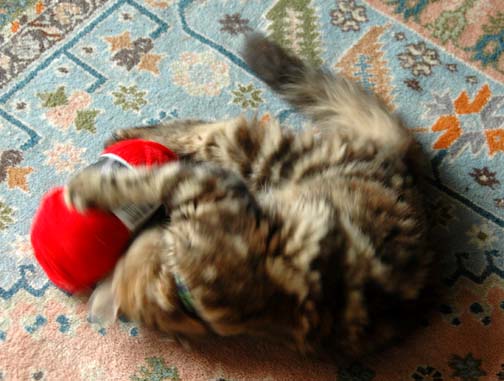
You will remember that the very dear and beloved Muffy the Yarnslayer finally passed on to the Happy Hunting Grounds earlier this year.  For a time, therefore, the stash was quite safe.  But as I was photographing the new acquisitions, small Mishka (growing by the day) decided it was time to make her bid for the title she felt was hers by right.


After all, if they will leave these nice bouncy soft balls lying about, what is a girl to do, ignore them?  Not!


I realise that this is rather a blurred picture, but the speed with which that yarn was skilfully hooked from the chair, dropped to the ground, and attacked with full energy beggars belief.  I did rescue it, since it still has a job to undertake, but gosh, it's tempting to unload a whole fleece on the carpet just to see what she would do, isn't it?

What do you think?  Has Mishka proved herself worthy of the title of Yarnslayer yet?  Or should we try the Fleece Test?

Now - going to the recycling centre is usually regarded as a way of getting rid of all the surplus in the house, the garage, the shed, lying around untidily.  Or it should be.  DH and myself have always been incurable collectors, snappers up of unconsidered trifles, veritable truffle hounds when it comes to other people's discards.  Yesterday I was virtuously unloading plastic here, glass there, when DH casually said, 'There's a battered old Singer sewing machine over there in the skip with all the computer stuff.'  I knew I didn't need another one but I went to look all the same.  You owe that much courtesy to such a lifelong hard worker as a sewing machine, don't you?

Upside down, almost hidden by grey plastic computer bits, it didn't look promising.  But it was clearly old, hand-cranked, with some gold scrollwork still visible.  Hand cranked?  That's coming home with us!  Show me the crafter who can pass by any hand cranked sewing machine.


Here it is, with Mishka diligently studying for her Yarnslayer (Advanced) badge, which demonstrates competence not just in knitting yarns but in all other forms of threadwork too.

Cleaned it up excitedly, discovered that nearly all the paintwork was in excellent condition, and - incredibly - all the interior workings were there, right down to a full bobbin in the shuttle!  (Long bobbin and shuttle, not the later round kind).  A lot of bits are still seized up with rust, but currently taking advice on the best way to deal with that.  And it's not a Singer.  It proudly proclaims itself as a Harrodia Prima, provided by - who else? - Harrods of London.  To discerning wealthy customers only, one would imagine.


Of course there were many brands of sewing machine back then, often manufactured elsewhere and then badged up by different stores or suppliers.  So you look further.  Like here, on the back.  Can you just see Made in Germany on the main column there?  That puts it very definitely before World War I.  Once hostilities broke out, England imported nothing from Germany (I have a theory that the English 'throwing' method of knitting gained much popularity at this time too - Elizabeth Zimmermann remembered being scolded by her governess in England as a child for trying to use the Continental method, being told, 'That's German!  You do NOT knit like that!')  Did some research, and have narrowed the manufacturer down to Frister & Rossmann, a large industry in pre-war Berlin, thanks to a most useful website run by the delightful Alex.

So can you believe it?  An early 20th century (or, more likely, late 19th century) hand-cranked sewing machine, supplied from 'the top people's store', with all its workings complete, on a skip full of computer scrap in West Cork!  It made me feel warm and happy every time I woke up in the night and remembered it.  Oh I do wonder what its life story is?

Sunday, August 05, 2012

Climbing to Crom, and Saluting the Sun

It's Lughnasa, the month of August, and almost time for harvest to begin in Ireland.  Mind you, with the summer we've been having, the farmers will be lucky to get anything into their barns at all.  It's been the wettest on record, and pretty well the coldest too.  And yet, I know that many of my friends in the southern half of the world are experiencing hideously high temperatures and no moisture at all.  'If I could get over to your place, I'd dance in your garden in the rain,' wrote my friend Angeluna feelingly, from Texas.  'It's 109 deg here and I only go outside to refill the birdbaths,' says Linda in Oklahoma.   Here in the grey north we simply can't imagine temperatures like that.  My thoughts are with you, and here is a quick trip into Ireland's damp green landscape to cool you down.


Being the beginning of August, and therefore the great sun festival of Lughnasa  there is only one place to be.  Mount Brandon, down on the Dingle Peninsula in Kerry, where every year at this time the local people celebrate Lughnasa by the age-old tradition of scaling the mountain.  They call this Climbing to Crom, which links it to a very early pre-Christian nature god.  Today, of course, a priest or two will be among the climbers, and prayers are said at a grotto on the way up and on the way back, but the original ritual is still preserved, no matter what decorative vestments may be thrown over it.

The same celebration takes place at Croagh Patrick up in Mayo, where upwards of three thousand pilgrims made the climb at dawn this year, and there are several other mountains around the country, each with their own faithful followers.

It's not a harvest festival, but more a festival of first fruits.  The blackberries and froachans (bilberries, wild blueberries) are ripening, and in some counties they celebrate Froachan Sunday at this time, young people heading out to the hills to gather the fresh berries to bring home.  Yes, I know we can all buy jams and jellies at the local supermarket these days, but try to think back to a time when your life, and that of your family, depended on the crops you could grow?  July was always known as the Hungry Month in Ireland in earlier times, and probably in many other lands too.  You had used up all your carefully stored foodstuffs and had to wait, sometimes half starving, until the new crop was ready to cut.  The ripening berries were not just welcome, they were desperately needed.

When potatoes were introduced into Ireland around the 17th century, they became the eagerly awaited early August crop.  On this day the very first new potatoes were dug, and the family would have a celebratory meal, always remembering to say Go mbeirimid beo ar an t'am seo aris  ('may we all be alive at this time again.')  I still say it when I bring in the first blackberries, the first new potatoes.  It's nice to keep up the custom.

So why climb the mountain?  Well, it's the nearest you can get to the sun, and to the sun god Lugh, after whom the month of Lughnasa is named, to ask his blessing on a good harvest to come.  If he isn't thus honoured, he might just throw an unexpected thunderstorm or a battering bout of rain into the picture, and ruin the long-awaited crop.  Crom, the earth deity, would have been an earlier nature god, before the Celts came to Ireland.  You find references to him in different parts of the country, always associated with the land and crops.


Gosh, sorry.  I didn't mean to go into all that detail.  Blame the new book.  It's driving me mad in these final stages.  Here are some of the climbers, a few going up, some coming back down already after the long climb there and back.  You can just see the little base camp grotto there on the right, beyond the fence, under the trees.


There are several routes up Mount Brandon, two of them, on opposite sides of the hill,  bearing exactly the same name Pilgrim's Road.  This one was less frequented that day, but just look at these sentinel stones looming powerfully over the track, observing all that comes by.  Straight out of Lord of the Rings.  And it was a wild blowy day too, brief glimpses of sunshine giving way to driving mists as we drove up to the very end of this track to the point, in a deep dark valley surrounded by hills, where you had to strike off across the slopes and up into the clouds.  So mysterious you fully expected to see little shadowy figures darting from the shelter of one rock to another, dodging out of sight before you could see them fully.  Gollum or an elf?

The village of Cloghane was in full festive mood that day, with weary climbers returning to join their friends who were busy setting up stalls, organising dog shows, corralling the sheep for the shearing contest later on.


Gosh I remember well the days you'd be lucky to get a chipped mug of instant coffee anywhere on the Dingle Peninsula.  These days things are much better.  The local shop not only brewed up a fresh cafetiere of good strong brew, but also had delicious freshly-baked buns and cakes on display.  Locals were rushing in and out for loaves, still warm from the oven, or home-made raspberry and redcurrant jam (yes of course I bought a pot, how could I resist? First fruits, after all!)

After that it was a quick dash down to Brandon Quay a few miles away, for the Blessing of the Boats, another ceremony which takes place during the Feile Lughnasa.  That's something that has been observed since earliest times too, whether carried out by a clergyman or a druid, since the dangers of the sea have always been well known, and too many families have known the loss of a father, a brother, a son.  Do you know that incredible play of J. M. Synge's, Riders to the Sea?  At the end, when her last son is drowned, the old woman, Maurya, echoes Greek tragedy in her strange almost-relieved acceptance.

                 They're all gone now, and there isn't anything more the sea can do to me. . . . 


Here is Brandon Quay, looking lively and cheerful in the afternoon sunshine (the grey clouds had decided to go off and dampen somebody else's spirits for a while).  The Dingle lifeboat was there, and scores of smaller fishing craft.  You probably can't make it out from here, but there are traditional tarred canvas curraghs up on the slipway too.  They've been used as long as men have fished the coasts of Ireland and they're still being made today.


Ha, you thought I wasn't going to mention knitting, didn't you?  Well you're wrong.  The Ravellenics are on, which means thousands (possibly millions) of knitters around the world are somehow finding time to work on the most challenging projects possible, and achieve their personal best.  Me, I went for this cabled jacket in a gorgeously soft merino/silk from Malabrigo.  Cabled did I say?  This pattern has cables on cables, and then some.  There is barely a row when you can draw breath in between twists and lifts and crossovers.  But it will look stunning when it's done. IF it's done by the end of the Olympic Games, next Sunday...

Nice picture, isn't it?  Credit to DH once again.  He really knows how to capture both colour and texture.


But here's the one you wouldn't normally see - me retracing my steps carefully from the fence where we photographed the piece, gathering up the miles (well it seemed like miles) of unwound yarn from the ball which for some reason had decided not to come with us but wait further down the cliff until we should see fit to return again.  Sophy Wackles was no help at all.

Oh I almost forgot.  Those of you yearning to move to Ireland and cooler, damper climes (are you absolutely sure?  Haven't been able to hang out the laundry for months), I've found your house of dreams.


Now look at that.  On a quiet country lane, where right now the wild roses and fuchsia are running riot, with Mount Brandon on one side and the sea on the other.  Desirable residence?  I should think so.

Sorry?  Oh you want another angle to make absolutely sure?  OK.


Not exactly sure how many rooms, but you'd get a nice traditional kitchen anyway, with an open fire and one of those cranes for hanging the pots over it.  A settle bed would be a bench by day, sleeping quarters at night.  Then in the other room you could have a real bed, muslin curtains at the window.  Bathroom?  Well there is plenty of space outside.  Myself, I think a little stone outhouse would add the perfect touch.

All right, all right, don't all rush at once.  Maybe I should go look up the estate agent?


Here is another little spot I thought you might like to see.  I simply love places like this, a microcosm of the countryside.  An old stone wall, covered with moss, ivy, and small plants.  Two protecting holly trees leaning over it to frame the distant view.  The kind of place you'd like to have at the end of your garden.

See, a whole posting without mentioning De Cat?

Well since you insist...   Of course Mishka is progressing superbly, growing inches by the day.  She's discovered that trees can be climbed (although the reverse procedure is still giving a little trouble) and has perfected the art of popping up by Sophy's chair to pat both doggy cheeks with each paw in turn at full speed (really confuses Sophy, that trick).  And the other day, observing her graceful and effortless leaps from one piece of furniture to the next, across beds, down staircases, DH determined to capture her in full flight.  It took two hours, and hundreds of shots (thank heaven for digital photography, can you imagine the rolls of film?) but in the end -


Sunday, July 22, 2012

An Ancient Well and A Powerful Rock

Yesterday was one of those days given by the gods.  Here in Ireland you never take fine weather for granted.  How could you, since it only flashes into your life when it feels like it?  We've had weeks of rain and gloom, so waking up to a glorious morning with fleecy white clouds scudding across a blue sky was an irresistible invitation to go adventuring.


We headed for Ardmore, a little seaside village just over the border from Cork, in Co. Waterford.  It has the most spectacular scenery and on a day like this, strolling the cliff path and getting the scent of the grass and heather and the sea breezes was as heavenly as it can only be when you've endured those aforesaid weeks of drizzle and damp.


This was our first destination.  St. Declan's monastery and its associated sacred well.  What a setting, on the clifftops at Ardmore (the name, Ard Mor, means The Great Height).


Here is a closer look at the well with the stone surroundings carefully put in place centuries ago.  Next week will be the Pattern Day (probably from Patron as in patron saint) when thousands of people will gather to circle the well and monastery sunwise, while reciting a specific sequence and number of prayers, and take water from the well.  It's a ritual far older than Christianity in Ireland, going right back to the days of the pagan goddesses who guarded and oversaw the proper use of such vital necessities as land and water.  It's hard to imagine now, but just try to think of good clean water not as something that automatically comes out of a tap, but that has to be sought and, when found, treasured and thanked so that it won't dry up and leave you with no supply at all.  Our ancestors here knew the importance of water.  Sacred wells, springs,  and the sources of rivers were regarded as especially powerful since they were often entrances to the Otherworld where the Good People dwelt.

You can understand Christianity slapping one of their own male saints down on the site, blotting out the original water goddess.  They were never going to stop people coming here, so they might as well make it look like a Christian custom.  And the Pattern Day?  Coincidentally near to the beginnng of August, isn't it?  That's the great sun festival of Lughnasa, when the first fruits and grains ripen, and a celebratory feast can be held before the hard work of gathering in the harvest begins.  (DH and I will be heading down to Mt Brandon in the far west next week, to see the crowds climbing the mountainside for Lughnasa.  I'll bring you there too, promise.)

A little stream dances out from below the well and runs down through the grassy slope of the monastery grounds.  Sophy had a good long drink from this and even lay down in it for a while to cool her paws and thereby receive even more blessings from the goddess.


Then we went down to the beach to find St Declan's Stone.  It's quite a long way from the monastery and well, but it's been firmly associated with the same saint for the same reasons - there was no way that the people, accustomed to coming here for thousands of years to beg favours, were going to stop coming.  So Christianity thought up this wonderful story of St Declan sailing across the sea to found a monastery here, guided on his way by a huge floating stone which carried his bell on top.  When the stone landed on the shore at Ardmore, he knew he was in the right place.

It's always worth looking back behind the layers of legend and then back a bit further again.  Don't be afraid to lift each layer, even if it seems stuck firmly to the bedrock.  It isn't.  There are more underneath.  This stone is one of those glacial erratic boulders, which doesn't really belong on this shoreline, and is regarded as a source of great healing power .  If you crawl underneath (and DH has made this look quite simple in his picture, but up close it's quite a small aperture, believe me, I got very wet trying) it is believed that you can be cured of a number of ailments.

In ancient times, I would think this was one of those fertility or birth stone alignments, similar to the Men-an- Tol in Cornwall, for example.    Pregnant women would crawl through to get an easy birth, while those hoping to have children would do the same to achieve the desired result.  Wherever you find a difficult passage through a limited space in an ancient stone alignment, it is usually associated with this particular purpose.


There is a very beautiful round tower at Ardmore too.  Much more modern of course - around the 12th century or thereabouts - but DH couldn't resist framing it in this lovely outburst of flowering stonecrop on a limestone wall.


This is the memory that will stay, though.  Those magnificent cliffs, the sea as calm as a millpond, and the sky smiling down on the purple heather.  A day to thank the goddess for, indeed.

On the way back we explored a couple of minor lanes and boreens.


I insisted DH take this picture, so you could see the kind of lane he considers driveable.  There were places I thought we would just get stuck and have to remain, living caravan-style in the car and fetching milk and bread from the nearest farmhouse, a few valleys away.  Driving slowly along, the brambles (all in flower, with luck it will be a good blackberry season this autumn) clutched at the sides of the car, while the hazel saplings leant right in the open sunroof and tapped us gently on the head.  You could just see the young hazelnuts forming, but they'll be a while yet.  Our ancestors would have depended on autumnal bounty like nuts and berries and we shouldn't scorn them either.

Is there any knitting at all going on, I heard someone ask plaintively, or is it going to be all kittens and travel from now on?  Not a bit of it.  Been working on far too many projects since the start of the year, and the half of them not finished yet, shame on me.


There was this nice ruffled shawl, a la Duchess of Cambridge, which was whipped up in a boucle yarn of which I had a large cone (stashbusting, you see, stashbusting!).  That, at least, got finished.

And it made me feel so virtuous that I headed off to This Is Knit in Dublin to find a suitable Aran weight to make a stunning jacket as my personal challenge for the Ravellenics, coming up on July 27.    As a digression, let me exclaim with delight upon the re-blossoming of knitting and yarn crafts generally in Ireland. Those of you who have been with me from the beginning will remember the many loud lamentations concerning the total unavailability of lovely things like Local Yarn Stores or indeed yarn of any kind.  It took its time, but at last you can find half a dozen knitting magazines in my local market town, and some really good yarn shops in Cork and Dublin.  Vibes and Scribes in Cork deserves a mention too, for seeing the future and having the courage to seize it when knitting was still very unfashionable here (too many memories of having to knit Aran sweaters for household finances).  Which brings me back to that Aran weight..


Of course I didn't end up with Aran weight at all, but this stunning kettle-dyed silky merino from Malabrigo which is only DK (sport?  worsted?) weight.  That's OK, we can adapt.  And the people at This is Knit were simply lovely and I had a great time. Worked a big swatch while returning triumphantly home on the train, to get the feel of it, and on the strength of that have now decided on a completely different pattern - the Debbie Bliss Cabled Jacket, which will be soft and drapey enough to show off this yarn as it deserves to be.


And of course there was some dyeing.  Here is the basketful I'm going to put up on eBay tonight (unless any of you contact me first of course, to say you can't live without one of them).  Back row three greens:  Fresh Lime and Olive Grove, both merino/tencel fingering, plus Water Lily, which is merino/silk fingering.  Front row, Firebird, a real tour de force of overdyeing, if I say so myself, and Summer Skies, both merino/tencel, plus Wild Roses in merino/silk.  All delicious and happy colours.  If I do get them up on eBay (they tend to sell before I ever get to that point) you'll find them under Celtic Memory.

See, a whole posting without a kitten in sight!  But where are my manners?  I never even introduced her properly.  She is of good breeding, mother an exquisite red Maine Coon, father a long-haired European domestic tabby.  Want to see her when she was very little, with her mum?  Thought you might.


Why do I look different?

She did take those first steps into the garden the other day, with Sophy, who has constituted herself Nanny in Chief, in careful attendance.  It was all a bit too much to take at first for someone who had thought World consisted of a couple of rooms, and she peered out from the terrace with a very worried face before venturing further.  No, no more pictures, I promise.


Oh all right then, just one.

Tuesday, July 17, 2012

The Sadness of Sophy, The Serenity of the Sea, and a Storybook Ending.

Let me start by apologising if this post looks a bit untidy.  New Blogger has its own ideas of how it should run, and it isn't very helpful about telling me how to achieve a neat effect.  It can only get better.  Onward!

Things got kind of sad here earlier in the year. You will remember that Maeldun the Wanderer Kitten came to join us, but then left us far too soon. Shortly after that, the dowager duchess Natasha de St Petersburg II also handed in her room key.

Dear old Muffy the Yarnslayer did not long outlive her half sister. She got tireder, weaker, and finally in early May (old May Day now that I come to think of it, which is of course eleven days later than the current May 1) we couldn't pretend any more that she wasn't suffering, and took a very hard decision.

 Didn't want to talk about it then, don't want to talk about it now. Please.

But the row of little headstones in the orchard was getting a bit much. And of course all these losses had a dreadful effect on poor Sophy, who had lost her wandering companion, Maeldun, and then both her comforting aunts in a very short space of time.


She took to moping on her favourite chair, uninterested in walks, rambles in the garden, anything really.

Now, I hear you exclaim, was the time for that New Black Kitten to play her part, surely? To come forward with messages of comfort, and paw cuddles, to reassure Sophy there was still a friend around?


The heck she did. Black Brat (and that wasn't the word I first typed, believe me) turned into a monster. I think she'd always been one in waiting, but nervousness on first arrival here had hidden her true character. She cuffed Sophy, she hissed, she spat, she even drew blood on a couple of occasions. And of course, the bigger she got, the more trouble she could cause. If I had known when I picked up that kitten that she had been tossed by an Alsatian when very tiny, I wouldn't have taken her. But I only found out afterwards, when enquiring delicately into the possibility of early traumas. That experience, combined with being born a barn cat to a very wild mother, and I knew it wasn't going to work.

 Oh I kept on trying, hoping that somehow she would soften, but she just got worse as she became more confident. The heartbreaking bit was seeing Sophy bringing toys and little offerings to the cat's basket, with pleading, imploring eyes, and receiving only a loaded claw paw across the face in response. So eventually I persuaded a friend who had given Black Brat's brother a home, to try taking her too. She was doubtful but the cat had no such reservations. She and her brother welcomed each other with open paws and proceeded to celebrate in a junket of mayhem and chaos that doesn't show any signs of abating several weeks later.

No, of course I didn't like doing it.  What cat lover would?  But Sophy's heartbreak deserved more attention than a little wildcat's shenanigans.  A solution had to be found.

And it was found.  But we had to wait for it.  It wasn't old enough to leave Mum yet.  So Sophy had to be patient.  If you can discern that Access All Areas badge on her chair, by the way, it is there because she always insists on every single door in the house being open.  Doesn't matter if she doesn't need to use it right now, she must have it open and available.  Shut just one door, anywhere, wait five minutes, and you will hear disgruntled staccato yaps that continue unceasing until you give in and remedy the mistake.  Access.  All. Areas.  Did you HEAR me?  Access.  All.  Areas!


In the meantime, we took her out for plenty of fresh air and stimulating circumstances, in the hope that this would lift the gloom.  'Won't be long now,' we told her comfortingly.  'Things will get better very soon, you'll see.'  And Sophy stumped along, despair in every lineament of that small face.  She stumbled over stones, fell into rabbit holes, ignored the bracing sea air.


This was down at Toormore, not far from Crookhaven and Barley Cove in West Cork.  It was a fine afternoon during the school holidays, but as is usually the case in West Cork, we had this stretch of coastline to ourselves.  There are tiny orchids growing on that grassy headland, and wild pansies too.

Coming down by Drimoleague, I just happened to glance sideways down a tiny boreen, and saw this wonderful old bridge, which once carried the much-loved West Cork Railway.


The bridge still stands, built to last, although the train is long gone. I do really believe though that if you wait there late at night, you will hear the whistle of the train and hear the steady chug of the engine as it heads towards the bridge, carrying its passengers and freight safely to their destination. Maybe you could get on, but you wouldn't know what century you were in when you alighted at the next station, which could cause problems.


On the way home, we stopped to photograph a lovely battered old gate with the grass growing long around it.  Don't you just love these gates, in the middle of nowhere, which quite evidently haven't been opened in years?


And then there were these marguerites beautifully backlit by the late evening sun. So many lovely things to discover, even at the roadside.


But the happy ending, you shriek! Sophy's Solution!  What happened next? Well,at last, at long last, the solution arrived.


Tiny Mishka (Little Bear) was a bit confused at first, having only just left Mum, and not being at all sure about this strange new world.
But very soon she began to explore wonderful things like doors
and delightful dangling distractions
and discovering that one could after all climb these things oddly called 'chairs'.


 Did it work? Did it work? Well, of course at first there was a little worry, a tiny hiss or two. But Mishka had been carefully chosen from a household where not only had she been handled and cuddled from birth, but had also been sniffed and licked by two large dogs who liked cats. So the end result wasn't long in coming.


Sophy is lonely no more. Mishka leaps up quite happily and cuddles down to sleep in the comforting circle of her surrogate mother's warm furry body. And they are both looking forward to a day very soon when Nanny will take her charge out on a first exploratory journey around the garden. Happy times ahead.