Sunday, November 27, 2011

Long-Ago Places

You know the kind of place I mean. Where life seems to be continuing in another time warp, a far off century, and as you discover it, wander through its quiet spaces, you find yourself tiptoeing, listening for voices of other times, echoes of the past. There actually are long-ago places still to be found, and you can get to them if you go looking. As we did one day last week when at last the grey clouds gave way to sunshine. A chilly wind with it, but at least sunshine. So we headed for absolutely the best place to go when you want to forget all about traffic jams and roadworks and crowded city streets, the Black Valley. It's hidden in the mountains between Killarney and Kenmare and you can really only get there by letting it happen.


We stopped by Muckross on the way past the lakes of Killarney, and were lucky enough to see the native red deer also enjoying the rare November sunshine quite close to the road.


These are really shy creatures, our red deer. You will often see sika or fallow ambling through the woods, but these magnificent animals normally inhabit the high inaccessible mountainsides, only venturing slightly closer to human habitation in the winter months. So a good view of them near to the road put DH in excellent humour.

That good humour nearly hit a severe test when we finally reached Moll's Gap, the draughty cleft at the very top of the pass where a wonderful cafe (a real Last Homely House if there ever was one) provides sustenance to exhausted travellers. In previous years it has closed after Hallow-E'en and I only remembered this as the car growled the last half mile in low gear. Oh horror! No hot coffee? No jam and cream scones? What would DH say? I crossed my fingers, and Sophy Wackles' paws too, for good luck, and held my breath.


All was well! The Avoca Cafe (which also has a splendiferous shop, selling all kinds of knitwear and jewellery and titbits) had most sensibly decided to stay open until Christmas, and had decorated its windows in festive manner to say so. Thank heaven in a crazy world for small delights like this! The view from its windows over the mountains is heartstopping.


Refreshed (and yes, we kept some raisins from the scones for Sophy Wackles, sulking in the car) we put the car in gear, pointed it sort of west, and hoped that once more the hidden path to the valley would be open. It was. Without really seeing how it happened the car was suddenly no longer on the main road, but bouncing down a steep little boreen which twisted between grey rocks and furze bushes, carrying you ever further from the everyday world. If you were very alert and organised (the kind of person who folds maps perfectly, and has a tick-list for every moment of the day, every point of interest) you probably wouldn't have a hope of getting on to that hidden road. It has, as I've said before, to happen by chance.


And so we came down at last to the Black Valley.


See what I mean about a long-ago world? This boreen surely has only known black-cloaked countrywomen carrying baskets of butter and eggs, the occasional creaking cartload of turf cut from the bog. Traffic lights? Bus lanes? Gridlock? Horns, engines, exhaust fumes? Another existence. The only sound is the call of a yearling lamb or the croak of a raven floating on wide black wings from one side of the valley to the other.


We chatted with the locals, who were pleased to pass the time of day, and then thought we had better find a drink for Sophy Wackles.


There is something deep-rooted, atavistic, in pushing underneath the overhanging boughs of ancient trees and glimpsing running water up ahead. You almost instinctively pause before leaving the shelter of the woods and check the open ground to see who or what is there, who has found this vital source before you. So must our ancestors have done, thousands of years ago, and we still retain some vestige of those survival instincts. You can't help but wonder how much of the old ways we have forgotten. Maybe it is possible to redevelop, rediscover natural knowledge that was second nature to our forefathers and foremothers? Wouldn't do any harm to try anyway. Sniff the wind instead of looking at the weather forecast on TV.? Check the good or bad feeling in a building before entering? Tune in to the wellbeing of friends and family before picking up the phone or writing an email?


The river bank was welcoming, however, and Sophy got her drink from a side pool. The waterfall was in full explosive spate after all the rain we'd had lately. For days after a downpour the water continues to flow down from the hills and increase the river's strength considerably, so we kept the small dog well back from the main torrent.


Oh look, oh look! A rainbow! Right across the valley! And it's ending right here by this rusty gate! Quick, get a spade and let's look for the crock of gold!


Thing about that legendary crock of gold, though, is that you're not meant to find it. Or if you do, you have to know what is best to be done with it. It's not like winning the lottery, it's more like a challenge to see how you will behave, how you will handle the responsibility it brings. Much better to leave it there, and make a wish on the rainbow.

The Black Valley was heavily populated at one time - as was most of Ireland - but now it's a silent place, with only faint traces of its history to be found. That was one reason we had come here at the ending of the year - it's much easier to discover those echoes of the past in the low sunlight of winter.


Can you see those traces of old lazybeds, way up there on the hillside, just below the mountain shadow? Lazybeds is rather a misnomer - these were the hardest work possible. When there were too many people competing for the good land, others had to move further and further up into the barren ground to grow their food. The soil was far thinner here, and so they gathered what earth they could and piled it in little ridges, just high enough to grow the potato crop. Those people have long gone, but the outline of the backbreaking, heartbreaking ridges remains, thrown into relief by the cold sunlight of November.


And look at this lone tree atop that great grey rock, its strong wiry roots spreading down deep and holding firm against the winds which howl down this valley in winter. There is an ancient belief in Ireland that the Cailleach Beara, or the Wise Woman sometimes transforms herself into a thorn tree atop a rock, and there watches silently over her people and her land. Go out to this valley on a dark stormy night at the full of the moon, and you might see her float from her rock and ride the wind across the Reeks to the ocean, there to tryst with ManannĂ¡n mac Lir.


Here is the picture, though, that I carried away in my mind's eye, and now want to share with you.


Look at that. Can you see the tiny ruined cottage, at the end of a winding green lane, at the right hand side of the picture? Click on it if you can't, and it should come up in a larger format. Doesn't it tug at your heartstrings? The mountains to its back, and the entire valley opening out from its front door, stretching for miles, right to the Lakes of Killarney. What was it like to live there? Was it exhausting, draining, poverty-stricken? Or did they love their home and its surroundings and its simple serene lifestyle with a deep heartfelt love? Did they survive the Famine and if so, did they travel far across the ocean to a new world, one of rush and noise and crowds and anonymity? And in the blessed quiet of the night, did they often think back to the Black Valley and wonder if the stream still fell with a musical note past their cottage there?


Now that I look at the picture again, I see there is a thorn tree guarding the green lane leading to the homestead. Perhaps the Cailleach is keeping an eye on it, until such time as the family returns to its roots.


When De Next Book is done (deadline next February!!!) we are both deeply drawn to doing one called Echoes of the Past. And this lonely little cottage will be in it.

Saturday, August 20, 2011

In Which Wondrous Wanderings Are Undertaken in Wales, Muffy the Yarnslayer Suffers a Mishap, and The New Autumn Yarns Are Revealed


A soothing picture of the new autumn collection first. More on the yarns later, but this is to calm your fears about Muffy the Yarnslayer. She has been in the wars, and no mistake. I discovered her one afternoon in a hideous state, one eye totally wrecked, and the poor little dog in dreadful distress, trying to hide in her bed. I don't know what happened, since she was safely enclosed within the gardens, but obviously she ran into something sharp with considerable force. Rushed her to the lovely Dutch vet who lives not far away (just before the haunted castle, turn right up a very winding lane, beyond the two cottages...) and he sedated her and soothed her before turning his attention to a semi-hysterical Celtic Memory. Which is as it should be.


Several days of worry and telephoning, and the little warrior came home, now a very creditable Pirate Princess. When she's pretty enough for your sensibilities once more, I'll put on her velvet eye patch and show her off here, but not just yet. We'll let the fur grow back first.


There is definitely something to be said for not thinking too much. Muffy is now as happy as a sandboy, bouncing around and enjoying life. It was I who had to do the adjusting, but I'm getting there. And she will look very rakish with the eye patch.

Somewhat earlier than this mishap, we wandered off to Wales for a weekend. Had been wanting to try the Cork-Swansea ferry for ages, and since several things could be achieved on one trip, off we went. You sail at night, and arrive in Wales nice and early in the morning.

Gosh, I'd forgotten how twisty and winding the back roads of Wales can be - and just how much more crowded the UK is than Ireland (about 60m people as compared to 4m). This being high summer, every lane was jammed with caravans and cars proceeding at a snail's pace. And I was stressed because I wanted to get to several places before they closed...


HERE, for example. How long have I imagined getting to this little treasure cave hidden deep in the Welsh hills, and finally I'd made it!


You don't need me to tell you about the amazing Colinette colours.


Ran around wildly, trying to see everything at once, grasping at bright jewel-like colours very much like a greedy thief in Aladdin's cave. But time was marching on and we had to make somewhere ELSE before too long. And experience was already showing that short map distances could take till Tibb's Eve to traverse on a busy summer weekend in Wales. So onwards and upwards, until finally we crossed the invisible border into England and Cheshire -


And arrived HERE! Another long-wished-for-visiting-spot on the Celtic Memory memorandum pad. Metropolitan, where all good machine knitters want to spend the rest of their lives.

I'd had this recurring, maddening, problem with my trusty Brother KH230 and ribber. In that they simply didn't want to know each other. Working separately they were fine - bring them together, and disaster ensued.


Oh the simplicity of bringing your problem to the right place! Mark diagnosed the difficulty without even laying a hand on the double monster. 'Wrong clamps' he said, instantly. And went off to find the right kind. Who would have thought that the difference of a millimetre in the angle of clamps could cause such heartache and wasted yarn? Sure enough, once we'd fitted the correct ones, Carol worked several rows of perfect ribbing on the KH230 and all was well.

Of course there were other goodies to look at. Well, as we were there, and had a nice big car with us, it seemed only sensible. You would have done the same, wouldn't you? And these divine new (did you read that, no, I didn't say 'vintage', I didn't say 'pre-loved', I didn't say 'well used', I didn't say 'disaster zones') Silver Reeds were set up in the same room, so when Carol offered to show me how beautifully they worked, naturally I jumped at the chance.


Which sort of.... well, fortunately DH had gone off to photograph some bees around the back of the building (they're farmers too, Carol and Mark, isn't that nice?) so we were able to slip a couple of rather heavy long boxes into the back of the car, then hastily conceal them with the now reinstated old machines plus a few raincoats (can you see the wet ground there? It was simply throwing it down by this time).


Waving fond farewells (but I'll be back, I'll be back) we next headed for Chester, although fortunately didn't have to hit the rush-hour maelstrom that is the ring route around this lovely old town. Chester itself is exquisite, but the traffic isn't. We were aiming for a peaceful little village outside, with its own cricket pitch and venerable trees. Where my dear friend Andy, supplier extraordinaire of undyed yarns, hangs out.


Andy was very busy getting ready for a trip across the herring pond to - guess where - Sock Summit no less! He was going over to meet up with a major client of his, the lady who supplies undyed yarns to you New Worlders. So now you know where your undyeds come from, don't you! (The horse isn't going to America, though, he thought he'd hang around and wait for the hunting season to start.)


The car was getting pretty full by this time (although the packs of yarn came in handy for cushioning the delicate Silver Reed machines) and it was with a distinct sense of relief that we turned the car back towards the Welsh border. (The credit card was pretty relieved too, I can tell you. It had had some serious work to do on this outing. Lucky we don't make trips like this too often.)


If you're going to stay in Wales, then do it properly. No predictable hotel chains. Go for something with age and character.


This is Bodidris Hall near Wrexham. Every period from medieval downwards, and mentioned in the Domesday book too, I shouldn't wonder. Creaky staircases, vast panelled rooms, and the wonderful scent of beeswax everywhere. Owls calling outside at night, which delighted DH. And food to dream of. In fact the overnight charges are exceptionally reasonable, while dinner would verge on the medium to expensive, so it all balances out in the best possible way. Discovered some incredible herbs and seasonings, including - could it have been red amaranth? Somebody enlighten me, quick! Whatever it was, it added the most piquant flavour to the salad.

Next morning we popped over to Trefriw Woollen Mill


where, it being Saturday, the looms were unfortunately silent, but this was more than compensated for by the fascinating dye and fibre gardens, which held all the plants that spinners and weavers have used for centuries to create both yarn and colour.


Could have wandered through these for hours, seeing all the different plants, and reading the carefully handwritten labels telling you which one did what, and where it originated.


But it was more than time for DH to have his share of the fun on this weekend, so without further delay we headed straight for Gigrin Farm near Rhayader where he could indulge his passion for wildlife photography to the full.


The red kites are fed here at exactly the same time each day (yes, the owners do allow for winter and summer time changes, the kites don't carry watches) so around 3pm you are treated to a spectacular display which would not otherwise have been seen since the Middle Ages when these birds fulfilled a most useful function of clearing up carrion and general rubbish.


Stunning birds, aren't they? That forked tail is the quickest way to identify them overhead.


And so we wended our way, tired and happy, back to Swansea and on to the ferry home, loaded down in my case with future projects and in DH's case with thousands of digital pictures to be processed. (In fact the sea crossing was so long that he had time to do most of it on board, and process these for me too - thanks, sweetheart!)


Some of that yarn I got has already been dyed up for the new Celtic Memory Autumn Collection. It's a rather special blend this one, being superwash merino fingering with a sprinkling of delicate gold or silver throughout. Utterly beautiful when dyed up in different shades. You can see some of them waving in the breeze at the top of this post, but I'm so proud of them that I'll let you see sneak closeup previews as well.


Here is Rose Gold


and this one I have called Silver Truffle, because it reminds me of the most mouth-watering milk chocolate truffle, lightly dusted with silver leaf. Good enough to eat. I'll be listing them on eBay tomorrow.

Oh I forgot. There has been knitting! And crocheting too.


I made the South Bay Shawl for myself, and enjoyed it so much, I made one for my friend Eileen as well.

These are so quick and easy to work that they would make ideal gifts. As long as I remember that fact in the frenzy of December!


And this is the Monarch Shawl, another beautiful pattern and extremely handy accessory for throwing round your neck on cooler autumn days. Not at all difficult to knit, by the way - I am amazed at how effective such simple patterns can be if you block them strongly. Added beads to all three of these by the way - currently going through a serious bead craze.

Enough for now. Off to dye some more yarns, play with Muffy (she's been getting a lot of attention lately and is enjoying it thoroughly), and try to summon up the courage to strike up a relationship with the new Silver Reed aristocratic knitting machines. Actually I have done a little bit in that direction already. Made a rather elegant kimono jacket in black alpaca, faced with bright pink, because it didn't involve using the ribber at ALL. (You can see where my hang-up lies, if that isn't too much a mixing of metaphors. Ribbers equal trouble where Celtic Memory is concerned. It's a hang-up that will have to be taken down, shaken out, and sorted before long.) And I'll show you the kimono jacket when I've finished sewing up the facings.

And next time I promise I will tell you about breakfast with that sorcerer in the wilds of Iceland.

Monday, July 11, 2011

The Tomb of a Goddess, Lost Wells, Secret Caves, And What Blogging Has Given To You

Sorry I'm a day late with this promised posting - was having breakfast with a sorcerer in the far far north of the world. No, really. Tell you about it another time


I know you all want to hear who's won the Connemara Twilight shawl kit so let's not delay but sort that out. And gosh, it isn't easy! What lovely heartfelt observations and such unerring instinct for knowing what is really valuable in life. I wish I could post shawl kits to every single one of you, but that would reduce me to beggary and I'd have to come live with all of you in turn, which might not be exactly to your liking.

I've narrowed it down to three:

Lilacs4Angels, you wrote:

I think, for me, that blogging takes us away for a bit. We travel the world through the words of others. And when we think our world is just going to fall apart for one reason or another here comes a blog from someone who's world has already fallen apart.For another day our world will stay together as we give encouragement to another to keep going.


My Heart Exposed, you described your journey


from an enforced existence of craft-less life into a world where my creative spirit and colour are my driving forces.Blogging has brought into my world a private and personal space platform for me to expose my heart. I find it interesting at times when on certain days things feel all uphill, I look back on what I wrote on that day say one, two or even six years ago. That way I can always see that despite the difficult times or uphill moments, I am actually travelling forwards never backwards. So blogging has also given me the opportunity to look at myself, value myself and have the courage to just be me. I've never had that before, I didnt even know who ME was.And that is an extremely powerful piece of knowledge to have in ones make up, I'd be lost without my little piece of the world wide web now.
And Kathleen C, you voiced the feelings of many, I think, when you said:


I have met people both virtually and in real life that I never would have connected with if not for their blogs. I have had glimpses in other people's homes, lives and countries and it has broadened my view of the world. I have been inspired to create and make and learn new techniques and skills... sometimes even if I wish I wasn't (I do NOT need to learn another hobby skill, I do NOT. But it looks like I'm going to start quilting).And that's just the expressable. The inexpressable, the sense of connection and friendship... it makes no logical sense as I certainly don't know them. I don't even comment sometimes. But these bloggers still feel like friends.


Like I said, you all deserve prizes for the way you wrote about what the world of blogging and the worldwide web have meant to you. But these three captured the essence most vividly, I think. So what the heck, the three of you get prizes! PM me if you're on Ravelry, email me if you're not. There is a link on this page for both.


I'd like to add this final point. We really are a huge force for good power in the world, we bloggers. We have the ability to influence decisions and make changes that need to be made. Don't neglect your power. If we believe we can, then we will move mountains.


And speaking of mountains, let's get back to where we left that road trip in northern Ireland, shall we? I think we left the rattly little green bus by Dunluce Castle, so climb on board and we'll clank off around by Malin Head, the northernmost point on this green isle, and cross Lough Swilly by a lovely little ferry into County Donegal.


See this huge stone circular wall looming on top of the hill? That's Grianan an Aileach, an ancient royal fort of the O'Neills, glowering down over the valleys and loughs, daring any invader to come close enough for a fight.


And here is a clever fish-eye shot of the interior (don't know how he does that). In ancient times, of course, that nice clean grass sward would have been jammed with little huts and bothies and fires and equipment, but it's still pretty evocative as it is, with the wind whistling over the ramparts and only the lone cry of a curlew to break the peace.

Now this signpost excited me very much.


Look at that name. (On some nearby signposts it was spelt Beltany, but that was fine - spelling didn't get standardised until very recently - late 19th century in some places, and when you have both Irish and English versions of place names as you do here, it's anybody's guess.) If ever I saw a clear surviving link to the ancient rituals of Beltane or Bealtaine, May Day, that's it. And it's the first such example I've seen. Most stone circles are named for the present townland where they stand. This is a rare exception. Naturally we hurled ourselves out of the car and climbed a steep lane. We were breathless by the time we got to the top and found an old gateway .


Right at the top of a lonely hill stood this massive stone circle, absolutely radiating power and the memory of ancient rituals performed here millennia ago.


'Was that one left out?' DH wondered, as we went to inspect this tall stone standing some distance from the others. Somehow I don't think so. It's at times like this you get really frustrated at not being able to put yourself back in time, to see exactly what the rituals were, and how the single great stone played its part in relation to the circle.


What do you think of this? A big mound of stones behind a house, right? Well, not quite. That untidy pile is in fact The Heapstone, the largest ancient cairn in Ireland outside the Boyne Valley. It might look recent, but believe me, it isn't. I put in this picture so you could see how close the past and present mingle in rural Ireland. Kind of nice, isn't it? But there's more. There's always more! A simply lovely traditional legend in this case. That huge cairn, you see, hides a very ancient sacred well of healing, used by the Tuatha de Danaan to cure their battle wounds. But their enemies cunningly came by night, every soldier carrying a stone, and they filled in the well and piled the stones high over it, so that next day, after a fierce conflict, the Tuatha de Danaan could not reach the healing waters, and so passed from the living world to the green hills forever.


It's worth another picture, isn't it, now that you know the full story? Wouldn't you love to dig to see if the well is still there? Because of course it must be! It has to be! Maybe if we went water divining...?


Here is a massive dolmen at Bloody Foreland. As you can see, the weather was turning slightly damp, but that, if anything, emphasised the dramatic size of this great monument to ancient hard work. Can you imagine how much effort it must have taken to raise that gigantic capstone?

Damp weather or no, Donegal was simply beautiful and I didn't want to leave. It has been such an isolated region for so long, that old traditions and customs have lingered there, untouched by modern ideas, and there is so much more to find out, to learn. Plus I didn't even get to Kilcarra, to see if there is a back door with a bin of discontinued or discarded yarns! Next time, next time... We had perforce to continue down the deeply indented west coast and into Sligo, the country of Yeats.


This dolmen was at Carrowmore, probably the largest collection of megalithic monuments outside Carnac in Brittany. But do you see that hill rising behind the dolmen, with the mound on top? No, maybe you can't see the mound at that distance. Wait a minute.


There, can you see it now? That is Knocknarea, the fabled tomb of Queen Maeve, who was herself of course a reincarnation of one of the ancient goddesses who ruled Ireland before a more patriarchal religion took over. There she lies, sword probably ready to hand if I know her, waiting for the moment when her country demands her to fight once more. Remember Yeats' poem?


The wind has bundled up the clouds high over Knocknarea

And thrown the thunder on the stones for all that Maeve can say...


Now here is somewhere completely different, the total antithesis to powerful goddesses and the old ways:


It's no good. I can't be professionally objective about this place. To put it mildly, it gives me the screaming ab-dabs. That looming, threatening bastion out there in the lake - it puts me in mind of a prison. Which it is in one way. Once you're out on that island, there is no escape until the little ferry boat chooses to take you. And yet, for many it is a place of refuge, of therapy, of peace. It's Lough Derg, of course, St. Patrick's Purgatory, where not so very long ago the faithful would starve themselves for days and nights while making the rounds of the various praying points, often on their knees. Perhaps they still do, even in this rather more self-indulgent age. I can't be objective because my own mother went there many years ago, on more than one occasion, and I remember the condition she was in when she came back. Small as I was, I hated Lough Derg with an intensity that has not, apparently, faded.


But the historian in me is interested, because like so many other pilgrimage sites in Ireland, Lough Derg is really a far older place of worship. Underneath that vast church you see on the right of the picture there are deep caves. Caves that have been officially closed and unreachable since the early 1700s when the then Pope ordered their effacement from general knowledge. In ancient times, this island was where the wise men, the druids, would come in search of enlightenment and knowledge. They would stay in the depths of these caves for several days and nights, starving themselves until they saw visions and made contact with the Otherworld. Shamans in North America would do the same thing. It became the practice in later centuries for others in search of knowledge and answers to come to the caves too, and endure the same rigorous conditions. However, the Christian church disapproved of self-education of this kind, and closed off the caves forever. It is very significant, though, that people are still drawn to that island, still stay there to fast and pray. They're following the old ways, even if they don't realise it

Onward, onward. We've miles to go yet


An hour's drive, and we're at another site of pilgrimage, the great Croagh Patrick in Mayo, where at Lammas-tide, the beginning of August, thousands climb the mountain, some in bare feet.


Even when we were there, well before Lammas, there were enthusiastic climbers making their way up the long rocky path, trodden by centuries of believers. Millennia actually, because excavations on the top have shown beyond doubt that Croagh Patrick was used for ritual celebrations from ancient times. It's rather reassuring to see the old ways still holding firm, albeit under a different name, isn't it?

The evening was drawing on as we came down into Connemara.


It would have been lovely to stay until the evening darkened into twilight and the mountains became blue and purple, but it was still a long way home. Had to make do with creating those Connemara Twilight shawl kits instead when I was safely back among the stash.


But we did stop to take this picture for you, especially for those who count The Quiet Man among their favourite movies.


Yes, this is the very bridge where John Wayne stood, and in flashback remembered his mother talking of the old days and the cottage where he had been born. Thought you'd like it.

Friday, July 01, 2011

Of Moon Skeins, Beautiful Stones and Glimpses of Scotland

The moon skeins first, because you'll be wondering. We had this fun idea over on the Sock Madness group in Ravelry that we'd all go on a virtual magical mystery tour together (now that this year's madness has thankfully come to an end with a spectacular supersonic-speed win by Niella). These virtual trips are lovely because everyone can leap on the bus and we can stop anywhere in the world you want. Sometimes DH does look rather oddly at me when I come down from the study raving about the fun we've been having in some remote valley of the Himalayas, or in a yarn shop on Vancouver Island, but it is one of the great developments of the worldwide web, I think.

Anyway, the moon sheep (well how else do you get a moon skein, or indeed a moon fleece?) I suggested the bus should take a side jaunt into the hidden valley where the legendary Moon Sheep were to be found. You can only see these sheep by the light of the new moon - you know, when it's only the thinnest paring in the sky. And that's the only time you can roo the fleece as well, so you have to be quick about it. You know rooing, don't you? It's when you don't cut the fleece off, you pull out soft handfuls gently. It's how they made the yarn for the softest, finest Shetland shawls.

Everybody got so involved with moon fleece and moon sheep that I thought I'd better make a Moon Shawl. This was, in part, inspired by a simply lovely book I read recently, Twist of Gold, by Michael Morpurgo, about two Irish children who flee the Famine and journey across America to the Californian gold rush. The little girl is gifted a beautiful moon shawl by an old lady who befriends them in Boston, and they use it to shelter from the blazing sun by day, and to warm them by night, until they reach California's Grass Valley. I'd been reading the book, partly because I've travelled much of their route, but mostly because I was in London last week, interviewing the said famous writer. He is a simply lovely person, not at all affected by his fame and success (War Horse has opened on Broadway now, and Spielberg's film is due to be released in January 2012). We talked for hours, but the one thing I forgot to ask him was where he got the idea for the Moon Shawl. Michael, if you're reading this, will you tell me?


I'd never heard of a moon shawl before so I looked it up on the Net and found this exquisite antique example.


Then it seemed like a good idea to create some magical moon yarn myself.


and make a Moon Shawl too.


It's not quite finished yet. I'm using the Seaspray pattern in between the bands of plain stockinet, because it looks like the woolly backs of moon sheep grazing in their magical meadow, and the plain sections are the open land you have to creep across without being seen, to reach them.

Had to make up several of these skeins for web friends too, and of course they wouldn't be complete without their own little magical silvery project bag, would they?


All this was enormous fun, and took up a great deal of time which should have been spent working on De Next Book. But that's something we've all discovered from the worldwide web, isn't it? That we now spend far too much time enjoying ourselves in the virtual world instead of the real one?

Oh that reminds me! I almost forgot! It's my blogging anniversary around now, I'm almost sure. Let me go see. Yes, it was July 9, 2006. That's five years of posting here! And I could not have believed that I would make so many friends, discover so many new fascinating avenues of exploration, enjoy myself so much, learn to knit socks in two days flat, for heaven's sake!

Oh it's been so much fun. I'll have to give out a present. Let me look.


How about this? I've been making up some new shawl kits and this is Connemara Twilight. Sorry? Oh you want to see it out of the bag? OK.


A lovely mix of yarns, totalling 500m in all. Plenty for a shawl, stole, long scarf, even a vest. And it's yours. Well one of yours. Just tell me on the Comments what blogging (or reading other people's blogs) has brought into your life, and I'll award the Connemara Twilight Shawl Kit to somebody next week, the day after the anniversary (July 10). That all right with everybody?


Now let's get back to that virtual versus real life topic. I'd been reading too much and not travelling enough so a week or so back, DH and I took a trip up North, to explore the coasts of Antrim and Donegal. The roads are much improved these days, and it's possible to leave home around 9 and be in the Glens of Antrim for afternoon tea.


Can you see that misty line of land in the background, just visible between the sea and the clouds? That's Scotland - the Mull of Kintyre to be exact. Quite something to sit in the sunshine over tea and scones, and look at the Mull of Kintyre (somebody stop those bagpipes playing, will you?) This is the shortest sea crossing between Ireland and Scotland, and in olden times there would have been a great deal of traffic back and forth.


I wasn't quite sure how the Giant's Causeway would look. It's such a huge tourist attraction that I thought it would be a bit of a let-down.


But it wasn't. It was awe-inspiring, and utterly beautiful.


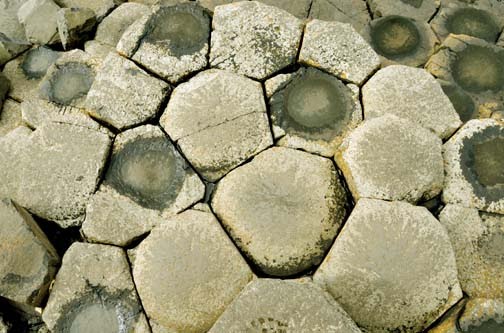
What I wasn't prepared for was the sense of happiness and peace there. It seemed quite natural to sit on those wonderful hexagonal stones and get on with the current gansey in the afternoon sunshine.


The stones are simply so lovely as they lie snugly fitted together, like a Flower Garden quilt. Some of them, worn hollow by the centuries, have little pools of rainwater, others have gentle shadings of yellow or orange from lichens, once used for dyeing yarn. I wanted to take the whole lot home with me immediately and have them in my garden to love and cherish. Fortunately for posterity, there were two main drawbacks to this plan. In the first place, each one is of enormous individual weight, and in the second place, the National Trust would have you clapped in irons in an instant. So there they lie, as they always have, through storm and sun, wind and rain.


We crossed the swaying rope bridge at Carrick-a-Rede, once used by fishermen to check their lines and pots off the sheer rocks. It's not the worst rope bridge I've been on, quite secure and sturdy, but the swaying can be a little off-putting. One imagines it would be quite frightening on a stormy day with the tide full in and the waves sending spray right over it.


From the cliffs above, you could see Rathlin Island in the distance. Another temptation, another destination to put off for another occasion. Trips like this are a constant discovery of other tangents and other paths, so that your original route becomes the centre of a positive spider's web of possibilities.


Just look at Dunluce Castle on its cliffs. Can you imagine living there, hurrying through the draughty passageways to the main hall and the welcome of a blazing fire? Dunluce was the home of the McDonnell clan until the early 1600s when, upon a large part of the kitchen falling into the sea one night, along with many of the servants, the wife of the chieftain refused to live there any longer. No pleasing some folk, is there?


Look, we have to leave it there for now. In the next posting, I'll take you into Donegal to see islands and cairns that hold strange secrets, ritual stone circles, and the tomb of Queen Maeve herself. Gotta go do some work!