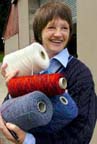
Anyway, the moon sheep (well how else do you get a moon skein, or indeed a moon fleece?) I suggested the bus should take a side jaunt into the hidden valley where the legendary Moon Sheep were to be found. You can only see these sheep by the light of the new moon - you know, when it's only the thinnest paring in the sky. And that's the only time you can roo the fleece as well, so you have to be quick about it. You know rooing, don't you? It's when you don't cut the fleece off, you pull out soft handfuls gently. It's how they made the yarn for the softest, finest Shetland shawls.
Everybody got so involved with moon fleece and moon sheep that I thought I'd better make a Moon Shawl. This was, in part, inspired by a simply lovely book I read recently, Twist of Gold, by Michael Morpurgo, about two Irish children who flee the Famine and journey across America to the Californian gold rush. The little girl is gifted a beautiful moon shawl by an old lady who befriends them in Boston, and they use it to shelter from the blazing sun by day, and to warm them by night, until they reach California's Grass Valley. I'd been reading the book, partly because I've travelled much of their route, but mostly because I was in London last week, interviewing the said famous writer. He is a simply lovely person, not at all affected by his fame and success (War Horse has opened on Broadway now, and Spielberg's film is due to be released in January 2012). We talked for hours, but the one thing I forgot to ask him was where he got the idea for the Moon Shawl. Michael, if you're reading this, will you tell me?
I'd never heard of a moon shawl before so I looked it up on the Net and found this exquisite antique example.

Then it seemed like a good idea to create some magical moon yarn myself.

and make a Moon Shawl too.

It's not quite finished yet. I'm using the Seaspray pattern in between the bands of plain stockinet, because it looks like the woolly backs of moon sheep grazing in their magical meadow, and the plain sections are the open land you have to creep across without being seen, to reach them.
Had to make up several of these skeins for web friends too, and of course they wouldn't be complete without their own little magical silvery project bag, would they?

All this was enormous fun, and took up a great deal of time which should have been spent working on De Next Book. But that's something we've all discovered from the worldwide web, isn't it? That we now spend far too much time enjoying ourselves in the virtual world instead of the real one?
Oh that reminds me! I almost forgot! It's my blogging anniversary around now, I'm almost sure. Let me go see. Yes, it was July 9, 2006. That's five years of posting here! And I could not have believed that I would make so many friends, discover so many new fascinating avenues of exploration, enjoy myself so much, learn to knit socks in two days flat, for heaven's sake!
Oh it's been so much fun. I'll have to give out a present. Let me look.

How about this? I've been making up some new shawl kits and this is Connemara Twilight. Sorry? Oh you want to see it out of the bag? OK.

A lovely mix of yarns, totalling 500m in all. Plenty for a shawl, stole, long scarf, even a vest. And it's yours. Well one of yours. Just tell me on the Comments what blogging (or reading other people's blogs) has brought into your life, and I'll award the Connemara Twilight Shawl Kit to somebody next week, the day after the anniversary (July 10). That all right with everybody?
Now let's get back to that virtual versus real life topic. I'd been reading too much and not travelling enough so a week or so back, DH and I took a trip up North, to explore the coasts of Antrim and Donegal. The roads are much improved these days, and it's possible to leave home around 9 and be in the Glens of Antrim for afternoon tea.

Can you see that misty line of land in the background, just visible between the sea and the clouds? That's Scotland - the Mull of Kintyre to be exact. Quite something to sit in the sunshine over tea and scones, and look at the Mull of Kintyre (somebody stop those bagpipes playing, will you?) This is the shortest sea crossing between Ireland and Scotland, and in olden times there would have been a great deal of traffic back and forth.
I wasn't quite sure how the Giant's Causeway would look. It's such a huge tourist attraction that I thought it would be a bit of a let-down.

But it wasn't. It was awe-inspiring, and utterly beautiful.

What I wasn't prepared for was the sense of happiness and peace there. It seemed quite natural to sit on those wonderful hexagonal stones and get on with the current gansey in the afternoon sunshine.
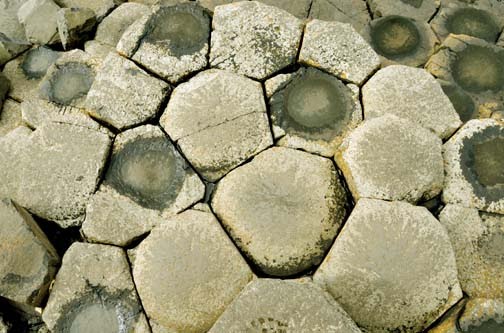
The stones are simply so lovely as they lie snugly fitted together, like a Flower Garden quilt. Some of them, worn hollow by the centuries, have little pools of rainwater, others have gentle shadings of yellow or orange from lichens, once used for dyeing yarn. I wanted to take the whole lot home with me immediately and have them in my garden to love and cherish. Fortunately for posterity, there were two main drawbacks to this plan. In the first place, each one is of enormous individual weight, and in the second place, the National Trust would have you clapped in irons in an instant. So there they lie, as they always have, through storm and sun, wind and rain.

We crossed the swaying rope bridge at Carrick-a-Rede, once used by fishermen to check their lines and pots off the sheer rocks. It's not the worst rope bridge I've been on, quite secure and sturdy, but the swaying can be a little off-putting. One imagines it would be quite frightening on a stormy day with the tide full in and the waves sending spray right over it.

From the cliffs above, you could see Rathlin Island in the distance. Another temptation, another destination to put off for another occasion. Trips like this are a constant discovery of other tangents and other paths, so that your original route becomes the centre of a positive spider's web of possibilities.

Just look at Dunluce Castle on its cliffs. Can you imagine living there, hurrying through the draughty passageways to the main hall and the welcome of a blazing fire? Dunluce was the home of the McDonnell clan until the early 1600s when, upon a large part of the kitchen falling into the sea one night, along with many of the servants, the wife of the chieftain refused to live there any longer. No pleasing some folk, is there?
Look, we have to leave it there for now. In the next posting, I'll take you into Donegal to see islands and cairns that hold strange secrets, ritual stone circles, and the tomb of Queen Maeve herself. Gotta go do some work!