Monday, July 11, 2011

The Tomb of a Goddess, Lost Wells, Secret Caves, And What Blogging Has Given To You

Sorry I'm a day late with this promised posting - was having breakfast with a sorcerer in the far far north of the world. No, really. Tell you about it another time


I know you all want to hear who's won the Connemara Twilight shawl kit so let's not delay but sort that out. And gosh, it isn't easy! What lovely heartfelt observations and such unerring instinct for knowing what is really valuable in life. I wish I could post shawl kits to every single one of you, but that would reduce me to beggary and I'd have to come live with all of you in turn, which might not be exactly to your liking.

I've narrowed it down to three:

Lilacs4Angels, you wrote:

I think, for me, that blogging takes us away for a bit. We travel the world through the words of others. And when we think our world is just going to fall apart for one reason or another here comes a blog from someone who's world has already fallen apart.For another day our world will stay together as we give encouragement to another to keep going.


My Heart Exposed, you described your journey


from an enforced existence of craft-less life into a world where my creative spirit and colour are my driving forces.Blogging has brought into my world a private and personal space platform for me to expose my heart. I find it interesting at times when on certain days things feel all uphill, I look back on what I wrote on that day say one, two or even six years ago. That way I can always see that despite the difficult times or uphill moments, I am actually travelling forwards never backwards. So blogging has also given me the opportunity to look at myself, value myself and have the courage to just be me. I've never had that before, I didnt even know who ME was.And that is an extremely powerful piece of knowledge to have in ones make up, I'd be lost without my little piece of the world wide web now.
And Kathleen C, you voiced the feelings of many, I think, when you said:


I have met people both virtually and in real life that I never would have connected with if not for their blogs. I have had glimpses in other people's homes, lives and countries and it has broadened my view of the world. I have been inspired to create and make and learn new techniques and skills... sometimes even if I wish I wasn't (I do NOT need to learn another hobby skill, I do NOT. But it looks like I'm going to start quilting).And that's just the expressable. The inexpressable, the sense of connection and friendship... it makes no logical sense as I certainly don't know them. I don't even comment sometimes. But these bloggers still feel like friends.


Like I said, you all deserve prizes for the way you wrote about what the world of blogging and the worldwide web have meant to you. But these three captured the essence most vividly, I think. So what the heck, the three of you get prizes! PM me if you're on Ravelry, email me if you're not. There is a link on this page for both.


I'd like to add this final point. We really are a huge force for good power in the world, we bloggers. We have the ability to influence decisions and make changes that need to be made. Don't neglect your power. If we believe we can, then we will move mountains.


And speaking of mountains, let's get back to where we left that road trip in northern Ireland, shall we? I think we left the rattly little green bus by Dunluce Castle, so climb on board and we'll clank off around by Malin Head, the northernmost point on this green isle, and cross Lough Swilly by a lovely little ferry into County Donegal.


See this huge stone circular wall looming on top of the hill? That's Grianan an Aileach, an ancient royal fort of the O'Neills, glowering down over the valleys and loughs, daring any invader to come close enough for a fight.


And here is a clever fish-eye shot of the interior (don't know how he does that). In ancient times, of course, that nice clean grass sward would have been jammed with little huts and bothies and fires and equipment, but it's still pretty evocative as it is, with the wind whistling over the ramparts and only the lone cry of a curlew to break the peace.

Now this signpost excited me very much.


Look at that name. (On some nearby signposts it was spelt Beltany, but that was fine - spelling didn't get standardised until very recently - late 19th century in some places, and when you have both Irish and English versions of place names as you do here, it's anybody's guess.) If ever I saw a clear surviving link to the ancient rituals of Beltane or Bealtaine, May Day, that's it. And it's the first such example I've seen. Most stone circles are named for the present townland where they stand. This is a rare exception. Naturally we hurled ourselves out of the car and climbed a steep lane. We were breathless by the time we got to the top and found an old gateway .


Right at the top of a lonely hill stood this massive stone circle, absolutely radiating power and the memory of ancient rituals performed here millennia ago.


'Was that one left out?' DH wondered, as we went to inspect this tall stone standing some distance from the others. Somehow I don't think so. It's at times like this you get really frustrated at not being able to put yourself back in time, to see exactly what the rituals were, and how the single great stone played its part in relation to the circle.


What do you think of this? A big mound of stones behind a house, right? Well, not quite. That untidy pile is in fact The Heapstone, the largest ancient cairn in Ireland outside the Boyne Valley. It might look recent, but believe me, it isn't. I put in this picture so you could see how close the past and present mingle in rural Ireland. Kind of nice, isn't it? But there's more. There's always more! A simply lovely traditional legend in this case. That huge cairn, you see, hides a very ancient sacred well of healing, used by the Tuatha de Danaan to cure their battle wounds. But their enemies cunningly came by night, every soldier carrying a stone, and they filled in the well and piled the stones high over it, so that next day, after a fierce conflict, the Tuatha de Danaan could not reach the healing waters, and so passed from the living world to the green hills forever.


It's worth another picture, isn't it, now that you know the full story? Wouldn't you love to dig to see if the well is still there? Because of course it must be! It has to be! Maybe if we went water divining...?


Here is a massive dolmen at Bloody Foreland. As you can see, the weather was turning slightly damp, but that, if anything, emphasised the dramatic size of this great monument to ancient hard work. Can you imagine how much effort it must have taken to raise that gigantic capstone?

Damp weather or no, Donegal was simply beautiful and I didn't want to leave. It has been such an isolated region for so long, that old traditions and customs have lingered there, untouched by modern ideas, and there is so much more to find out, to learn. Plus I didn't even get to Kilcarra, to see if there is a back door with a bin of discontinued or discarded yarns! Next time, next time... We had perforce to continue down the deeply indented west coast and into Sligo, the country of Yeats.


This dolmen was at Carrowmore, probably the largest collection of megalithic monuments outside Carnac in Brittany. But do you see that hill rising behind the dolmen, with the mound on top? No, maybe you can't see the mound at that distance. Wait a minute.
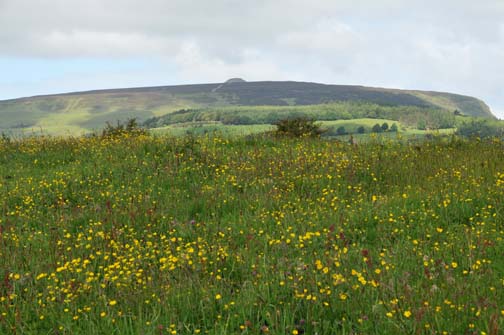


There, can you see it now? That is Knocknarea, the fabled tomb of Queen Maeve, who was herself of course a reincarnation of one of the ancient goddesses who ruled Ireland before a more patriarchal religion took over. There she lies, sword probably ready to hand if I know her, waiting for the moment when her country demands her to fight once more. Remember Yeats' poem?


The wind has bundled up the clouds high over Knocknarea

And thrown the thunder on the stones for all that Maeve can say...


Now here is somewhere completely different, the total antithesis to powerful goddesses and the old ways:


It's no good. I can't be professionally objective about this place. To put it mildly, it gives me the screaming ab-dabs. That looming, threatening bastion out there in the lake - it puts me in mind of a prison. Which it is in one way. Once you're out on that island, there is no escape until the little ferry boat chooses to take you. And yet, for many it is a place of refuge, of therapy, of peace. It's Lough Derg, of course, St. Patrick's Purgatory, where not so very long ago the faithful would starve themselves for days and nights while making the rounds of the various praying points, often on their knees. Perhaps they still do, even in this rather more self-indulgent age. I can't be objective because my own mother went there many years ago, on more than one occasion, and I remember the condition she was in when she came back. Small as I was, I hated Lough Derg with an intensity that has not, apparently, faded.


But the historian in me is interested, because like so many other pilgrimage sites in Ireland, Lough Derg is really a far older place of worship. Underneath that vast church you see on the right of the picture there are deep caves. Caves that have been officially closed and unreachable since the early 1700s when the then Pope ordered their effacement from general knowledge. In ancient times, this island was where the wise men, the druids, would come in search of enlightenment and knowledge. They would stay in the depths of these caves for several days and nights, starving themselves until they saw visions and made contact with the Otherworld. Shamans in North America would do the same thing. It became the practice in later centuries for others in search of knowledge and answers to come to the caves too, and endure the same rigorous conditions. However, the Christian church disapproved of self-education of this kind, and closed off the caves forever. It is very significant, though, that people are still drawn to that island, still stay there to fast and pray. They're following the old ways, even if they don't realise it

Onward, onward. We've miles to go yet


An hour's drive, and we're at another site of pilgrimage, the great Croagh Patrick in Mayo, where at Lammas-tide, the beginning of August, thousands climb the mountain, some in bare feet.


Even when we were there, well before Lammas, there were enthusiastic climbers making their way up the long rocky path, trodden by centuries of believers. Millennia actually, because excavations on the top have shown beyond doubt that Croagh Patrick was used for ritual celebrations from ancient times. It's rather reassuring to see the old ways still holding firm, albeit under a different name, isn't it?

The evening was drawing on as we came down into Connemara.


It would have been lovely to stay until the evening darkened into twilight and the mountains became blue and purple, but it was still a long way home. Had to make do with creating those Connemara Twilight shawl kits instead when I was safely back among the stash.


But we did stop to take this picture for you, especially for those who count The Quiet Man among their favourite movies.


Yes, this is the very bridge where John Wayne stood, and in flashback remembered his mother talking of the old days and the cottage where he had been born. Thought you'd like it.

Friday, July 01, 2011

Of Moon Skeins, Beautiful Stones and Glimpses of Scotland

The moon skeins first, because you'll be wondering. We had this fun idea over on the Sock Madness group in Ravelry that we'd all go on a virtual magical mystery tour together (now that this year's madness has thankfully come to an end with a spectacular supersonic-speed win by Niella). These virtual trips are lovely because everyone can leap on the bus and we can stop anywhere in the world you want. Sometimes DH does look rather oddly at me when I come down from the study raving about the fun we've been having in some remote valley of the Himalayas, or in a yarn shop on Vancouver Island, but it is one of the great developments of the worldwide web, I think.

Anyway, the moon sheep (well how else do you get a moon skein, or indeed a moon fleece?) I suggested the bus should take a side jaunt into the hidden valley where the legendary Moon Sheep were to be found. You can only see these sheep by the light of the new moon - you know, when it's only the thinnest paring in the sky. And that's the only time you can roo the fleece as well, so you have to be quick about it. You know rooing, don't you? It's when you don't cut the fleece off, you pull out soft handfuls gently. It's how they made the yarn for the softest, finest Shetland shawls.

Everybody got so involved with moon fleece and moon sheep that I thought I'd better make a Moon Shawl. This was, in part, inspired by a simply lovely book I read recently, Twist of Gold, by Michael Morpurgo, about two Irish children who flee the Famine and journey across America to the Californian gold rush. The little girl is gifted a beautiful moon shawl by an old lady who befriends them in Boston, and they use it to shelter from the blazing sun by day, and to warm them by night, until they reach California's Grass Valley. I'd been reading the book, partly because I've travelled much of their route, but mostly because I was in London last week, interviewing the said famous writer. He is a simply lovely person, not at all affected by his fame and success (War Horse has opened on Broadway now, and Spielberg's film is due to be released in January 2012). We talked for hours, but the one thing I forgot to ask him was where he got the idea for the Moon Shawl. Michael, if you're reading this, will you tell me?


I'd never heard of a moon shawl before so I looked it up on the Net and found this exquisite antique example.


Then it seemed like a good idea to create some magical moon yarn myself.


and make a Moon Shawl too.


It's not quite finished yet. I'm using the Seaspray pattern in between the bands of plain stockinet, because it looks like the woolly backs of moon sheep grazing in their magical meadow, and the plain sections are the open land you have to creep across without being seen, to reach them.

Had to make up several of these skeins for web friends too, and of course they wouldn't be complete without their own little magical silvery project bag, would they?


All this was enormous fun, and took up a great deal of time which should have been spent working on De Next Book. But that's something we've all discovered from the worldwide web, isn't it? That we now spend far too much time enjoying ourselves in the virtual world instead of the real one?

Oh that reminds me! I almost forgot! It's my blogging anniversary around now, I'm almost sure. Let me go see. Yes, it was July 9, 2006. That's five years of posting here! And I could not have believed that I would make so many friends, discover so many new fascinating avenues of exploration, enjoy myself so much, learn to knit socks in two days flat, for heaven's sake!

Oh it's been so much fun. I'll have to give out a present. Let me look.


How about this? I've been making up some new shawl kits and this is Connemara Twilight. Sorry? Oh you want to see it out of the bag? OK.


A lovely mix of yarns, totalling 500m in all. Plenty for a shawl, stole, long scarf, even a vest. And it's yours. Well one of yours. Just tell me on the Comments what blogging (or reading other people's blogs) has brought into your life, and I'll award the Connemara Twilight Shawl Kit to somebody next week, the day after the anniversary (July 10). That all right with everybody?


Now let's get back to that virtual versus real life topic. I'd been reading too much and not travelling enough so a week or so back, DH and I took a trip up North, to explore the coasts of Antrim and Donegal. The roads are much improved these days, and it's possible to leave home around 9 and be in the Glens of Antrim for afternoon tea.


Can you see that misty line of land in the background, just visible between the sea and the clouds? That's Scotland - the Mull of Kintyre to be exact. Quite something to sit in the sunshine over tea and scones, and look at the Mull of Kintyre (somebody stop those bagpipes playing, will you?) This is the shortest sea crossing between Ireland and Scotland, and in olden times there would have been a great deal of traffic back and forth.


I wasn't quite sure how the Giant's Causeway would look. It's such a huge tourist attraction that I thought it would be a bit of a let-down.


But it wasn't. It was awe-inspiring, and utterly beautiful.


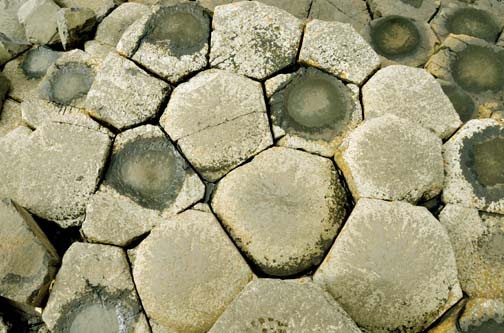
What I wasn't prepared for was the sense of happiness and peace there. It seemed quite natural to sit on those wonderful hexagonal stones and get on with the current gansey in the afternoon sunshine.


The stones are simply so lovely as they lie snugly fitted together, like a Flower Garden quilt. Some of them, worn hollow by the centuries, have little pools of rainwater, others have gentle shadings of yellow or orange from lichens, once used for dyeing yarn. I wanted to take the whole lot home with me immediately and have them in my garden to love and cherish. Fortunately for posterity, there were two main drawbacks to this plan. In the first place, each one is of enormous individual weight, and in the second place, the National Trust would have you clapped in irons in an instant. So there they lie, as they always have, through storm and sun, wind and rain.


We crossed the swaying rope bridge at Carrick-a-Rede, once used by fishermen to check their lines and pots off the sheer rocks. It's not the worst rope bridge I've been on, quite secure and sturdy, but the swaying can be a little off-putting. One imagines it would be quite frightening on a stormy day with the tide full in and the waves sending spray right over it.


From the cliffs above, you could see Rathlin Island in the distance. Another temptation, another destination to put off for another occasion. Trips like this are a constant discovery of other tangents and other paths, so that your original route becomes the centre of a positive spider's web of possibilities.


Just look at Dunluce Castle on its cliffs. Can you imagine living there, hurrying through the draughty passageways to the main hall and the welcome of a blazing fire? Dunluce was the home of the McDonnell clan until the early 1600s when, upon a large part of the kitchen falling into the sea one night, along with many of the servants, the wife of the chieftain refused to live there any longer. No pleasing some folk, is there?


Look, we have to leave it there for now. In the next posting, I'll take you into Donegal to see islands and cairns that hold strange secrets, ritual stone circles, and the tomb of Queen Maeve herself. Gotta go do some work!

Monday, April 25, 2011

Being A Tale Of The Pheasant, The Fox, The Robin and the Rabbits


These baby rabbits are too young to know fear. No bigger than the palm of my hand, out of the bushes they pop, to browse on the soft green grass of the lawn. A dog wanders past, they blink at it in wonder. I come by with a rake, and they move a few feet away in respect, but then return to their grazing.


The other morning, one came adventuring right up through the rockery, and peeped in the window from behind a clump of primulas. Next thing you know, they'll be sitting up to nursery tea and wanting stories read to them.


The robins are more careful. They had their nest built, the eggs hatched and the babies being fed before we even realised they were back at the old box in the shadow of the ivy-clad tree.


DH (who is ingeniously clever at these things, whereas I wouldn't even know where to start) unobtrusively set up a camera close to the nestbox, linked to his computer, so that he could sit at his desk and press a button whenever the parent bird appeared with food for the hungry nestlings.


All done without any birds being worried or upset. And, more importantly, without attracting the attention of opportunistic predators like magpies or crows, who would be delighted with a local fast food takeaway.


The blackthorn has been amazing this year. The flowers come out before the leaves, usually around March, but with the cold weather we've been having, it was delayed, and made up for it with a really splendid show of white blossoms on bare black branches. There will be a good crop of sloes this autumn. Tongue-dryingly bitter to the taste, with the addition of plenty of sugar and a little alcohol, they make a lovely soothing winter syrup.

It's been a lovely Easter weekend here. Chill winds, but sunshine most of the time. We went out to see what could be seen.


Early morning is a good time to come across someone like this splendid dog fox on his way home across the fields. He paused, watched us narrowly for a minute, then loped off again and was lost to sight in the ditch. Doubtless his poor wife is cooped up underground in the den, dealing with a brood of fractious babies, and with no hope at all of seeing the sun and feeling the breeze on her back for another month yet.


Up the Shournagh Valley there is an old old tin shed that was once a shop for the local community. I've met middle-aged men who waxed sentimental about going in there as children, and buying toffee bars with their hard-earned pennies. (Remember penny toffee bars? I recollect being much addicted to a real tooth-cracker that had peanuts blended in, and was known as Sailor's Chew.) Last time we were here, about five years ago, it wasn't as overgrown as this, but leave a car standing in West Cork for more than a week and the brambles and ivy will have it. The bright yellow kerria japonica, though, was in full bloom, and I took a few slips, to see if they would root in my own garden, and keep the memory of the country store alive.


On that previous visit, which was in autumn, we'd climbed a venerable apple tree and brought home bagfuls of fruit in triumph. This time the poor old tree was bent double under the weight of a crushing mass of ivy, but it was still determinedly putting out its blossom on every branch that could reach the light and sunshine.


Is there anything lovelier than apple blossom in spring, promising warm summer days followed by a rich autumn? Those selfsame children who bought penny toffee bars here back half a century ago probably sneaked around to the side of the shop in October to pick up windfalls, destined for merry games of snap-apple and bobbing for apples by the fireside at Hallow-E'en.


There was an old man, bent over his walking stick, waiting to cross the clapper bridge at Ballingeary as Sophy Wackles and I came over. I apologised for keeping him waiting. 'No hurry at all, girleen, no hurry in the world,' he said in that soft West Cork accent. And off he went, at his own peaceful pace, across the ancient flat stones and into the woods for a stroll. It's a while since I've been called 'girleen', and it made me smile whenever I remembered it during the rest of the day.


Spotted this pheasant glaring at us from over a hedge, and DH immediately stopped the car to set up his long lens. After some patient waiting, the bird obligingly flapped its wings and called hoarsely, to warn any other resplendent males in the vicinity that this was his territory and no mistake about it.


Look at the graceful curve of that wing. Wouldn't you love to create a shawl with that effect? Here, have a look at the full back view:


I simply love the way those primaries curve upwards. What little female pheasant in her sensible but boring plain brown dress could resist a man like that?


It was a nice wandering sort of day, with pauses here and there.


Of course the knitting came too. This was one of those easy, mindless projects that could be dropped down and picked up without too much worry. An Aran cardigan in Noro Shirakaba (never can remember that name, wonder why?), yarn picked up at Knitting in La Jolla simply ages back.


Here is a close up of one of the fronts. I inset a pocket halfway up, where you can just distinguish the little band of moss stitch. It's going very well, but I fear I won't have enough of the yarn to complete the full cardigan. If any of you live closer to a source of Noro Shirakaba than I do (it isn't generally stocked in Ireland or, I fear, the UK) do let me know, and we can do a trade or PayPal, OK?

And then it was time to turn for home. But not at speed. You can't move at speed on the winding narrow lanes of West Cork.


You wouldn't want to hurry tomorrow's milk and cream and butter, would you?

Monday, April 11, 2011

In Which A Thorn Tree Points The Way, And A Small Bird Prefers Wool To Moss

I meant to tell you last time, but there simply wasn't space. Which is why there will be a blue moon tonight, as Celtic Memory is posting again within the space of a week. Well it's not just to put in the extra bits - it's also to avoid that awful feeling when it's been let go too long, and the stories to be told, and the pictures to be shown, have piled up so high that even the thought of sitting down to post for several hours is appalling. No more. Nevermore! Going to post little and often from now on. Did I say that once before? Twice before? Anyway, the lovely story I meant to tell you last time. We had been out in North Cork on a job and were wandering home through the lanes when I bethought me to look out for lone thorn trees. This of course is for De Next Book. Of all the trees, the hawthorn possesses the richest folklore even today. You'll know the old song: All night around the thorn tree The Little People play, And men and women passing Will turn their heads away. But if your heart's a child's heart And if your eyes are clean, You need never fear the thorn tree That grows beyond Clogheen. Hawthorn comes into bloom on May Day. Or it would if the powers that be hadn't decided to change the calendar from Julian to Gregorian time back a few centuries ago (no, I'm not going into the details now, Google it if you want to, it's quite complex, involving the loss of ten days, then a change of mind, and a loss of eleven days instead, plus, believe it or not, a Feb 30 in 1712 to get it all sorted out finally, only it didn't.) So unless it's a particularly mild year, the lovely, milky-scented white blossom stars the hedgerows around the second week in May. (It's also why Twelfth Night or Women's Christmas is still celebrated, but that's another story.) You wouldn't believe how cross people were at having eleven days just snatched out of their lives. I mean, wouldn't you be? Go to bed one night, planning to plough and harrow tomorrow, plant the potatoes the day after, take the wife to market the following weekend... and then suddenly you're told 'sorry' (actually forget that, the Church never said 'sorry', wasn't its way) 'dem days are gone boy, you're going to have to hurry to catch up, you're almost two weeks behind in your work now.' Where the tarnation was I? Oh yes, the thorn tree, the fairy thorn. It's believed to possess considerable power in its own right, and also to be very much connected to the Good People. Of all the sacred wells and springs in Ireland (and we have thousands) the majority have a thorn tree growing next to them, and you'll usually find little scraps of cloth, yarn, offerings tied to its prickly branches. To damage a fairy thorn or, worse still, dig it up, is considered very bad luck indeed. And often you will see a lone thorn right in the middle of a wide ploughed field, because no farmer with any sense of tradition would dare to touch it. If you find a lone thorn growing on the edge of a rath, a lios, or fairy fort, of course, then it's doubly magical and doubly dangerous to lay aggressive hands on it. So as we were driving along, I asked DH to keep an eye out for just such a lone thorn, so we could get pictures of it. And then, over a hedge, I spied one that wasn't particularly typical, but would do for the moment, so we stopped in a farm gate. The farmer wandered out for a chat, and we explained what we were doing. 'Oh the thorn,' he said. 'I thought you were coming to see the stones.' The stones? THE STONES? What stones? 'Ah, it's The Sessions they call them. Never did know why, but that's what they've always been called.'


Look at this picture of the thorn tree. Look back there in the distance, slightly to the right of the thorn. See some dim grey shapes? Flipping 'eck, I had no idea whatsoever that they were there!


Up the lane with us, through a gate, and across a long field, never mind that the sun was setting. And gradually those strange grey shapes became larger, more definite.


Gosh, they were big. Six originally, you can see one fallen there, fourth from the left.


Here you can see the height of that end stone, the heaviest and widest of the six. Of course there is probably as much underneath the ground as there is above, so their original height would have been awe-inspiring indeed. A genuine stone row, but for what purpose? Leading where? Marking what?


Looked it up in the records as soon as we got home, where the name appeared as An Seisear or The Six. Maybe we misheard the farmer. That name would make more sense. Well thank you, thorn tree, for pointing the way. Wouldn't have spotted them without you. Yes, Celtic Memory is ashamed of herself for not knowing about An Seisear, but then, there are so many stone rows, stone circles, lone standing stones, within a stroll of home that you can't be knowing everything, I suppose.


That same day we'd passed through the lovely little village of Bruree just over the border in Co. Limerick. The name means The Seat of Kings, and certainly the kings of Munster used to live here in ancient times. It was a gathering place for bards and poets too, once or twice a year.


That ivy-covered bulk rising above the old graveyard is actually the medieval de Lacy castle, though it's not particularly recognisable. The stones and the ivy are probably old friends by now, holding each other up.


While I sat on a bench in the sunshine and dreamed of the past glories of Bruree, DH climbed nimbly up the old castle and took a picture of me, far below. Wish you'd all been there with us.


Sock Madness is proceeding apace, with the Norwegians beating everybody in terms of sheer speed. I simply do not know what they have for breakfast in the far north, but I certainly can see why the Vikings were so successful. Didn't hang around wondering about life, simply seized it with both hands.


I'm not as fast as that. Here are my Dangerous Turns, designed by the clever Maya. Love cables, and these are delightfully mirror-imaged. Using my own hand-dyed merino/bamboo in a colourway called Swirling Mists. I'd say they'll be a couple more days yet in the making. Also working on the Irish Mystery Shawl by Meagheen, which will take a lot longer, having lots and lots of stitches, not to mention those diabolic creations, nupps. But a gorgeous design, nonetheless. Using a beautiful Cashlana from Fleece Artist for that, in mossy green. Pictures when there are some worth showing.


In the meantime, I am glad to report that it is not only we humans who appreciate fine wools and the soft warmth they offer. At this time of year I usually put little handfuls of wool or dog hair out on the bushes for the birds who are busy making their nests.


Bingo! A bluetit (chickadee to you New Worlders) forthwith ceased his busy gathering of moss from the hedgerow and came straight up to investigate. 'Ooh, wool', he squeaked. 'Lovely, just what we needed for the babies. The wife will be pleased!' And he tugged and tugged energetically.


He hung upside down, determined to get the longest draw possible on the fibres.


And finally he hovered, wings beating vigorously, pulling the strands up, up and away, before flying victoriously off with his spoils. Isn't it nice to think that little nests will be cosy and warm in West Cork this spring? Go on, do the same. Put out dog hair after you've groomed out the winter undercoat. Do as my mother always did: hang a little net bag of yarn ends, scraps of wool, bright colours, from a branch, and then have fun in the autumn seeing the well-used nests which have incorporated your offerings.


Enjoy the spring. I gotta go finish some socks...